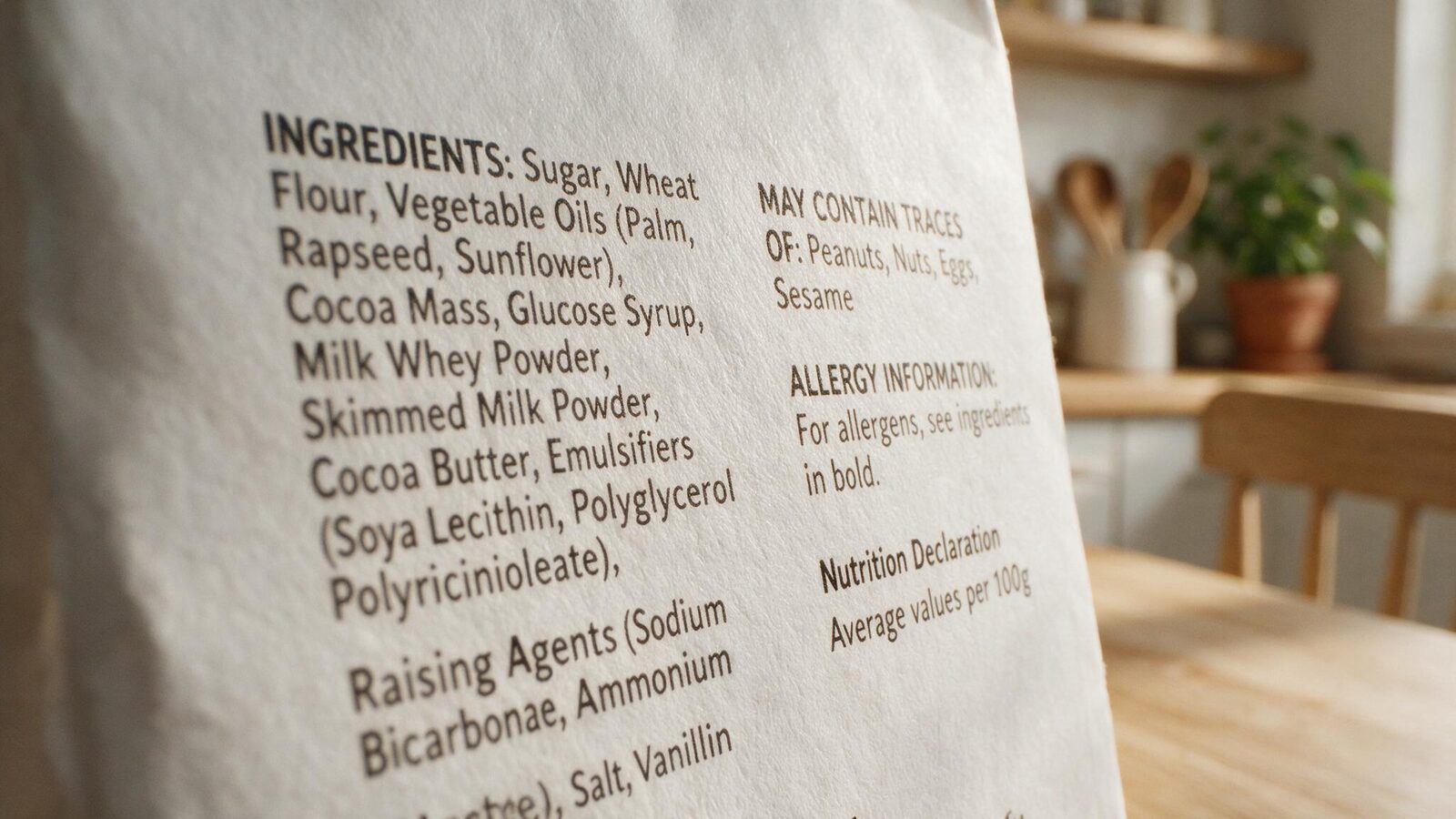
You turned a pack around and at the end of the ingredients list you saw this: E330, E415, E202. The first word that came to mind was probably chemical.
E330 is citric acid, the thing in lemons and oranges. E415 is a thickener produced by fermentation from corn starch. And somewhere in that same list there may well be a code that does deserve your attention. The problem is that they all appear in the same costume, and that costume pushes people into either panic or complete indifference. Both are wrong.
What the E stands for
E stands for Europe. When an additive has been assessed by the European food safety authority and permitted for use, it is given a number with an E in front of it. So an E number means the substance has been assessed and authorised.
The code says nothing about how natural or how synthetic something is. If water had a code, it would have an E number too. Vitamin C is E300. Baking soda is E500.
The first digit tells you the function:
E100s are colours. E200s are preservatives. E300s are antioxidants and acidity regulators. E400s are thickeners, gelling agents and emulsifiers. E600s are flavour enhancers. E900s are sweeteners and glazing agents.
Between panic and indifference
There are two camps online. One says every E number is poison. The other says they are all approved so none of it matters. Both are lazy.
The truth is this: additives are assessed one by one, and there are real differences between them.
For some, scientific committees have set an acceptable daily intake that is hard to reach through normal eating. Some carry an extra warning because they affect particular groups. Some have had their assessment updated with new evidence, and their authorisation changed as a result.
So the question is not whether there is an E number. The question is which one, how much, and for whom.
The ones that genuinely deserve attention
Certain colours and the attention warning. Products containing E102, E104, E110, E122, E124 or E129 must carry this statement on the pack in Europe: may have an adverse effect on activity and attention in children. It is not a ban, but it was not added for nothing. If you are buying for a child, it is worth a look.
Titanium dioxide (E171). Its use in food is banned in the European Union. The decision was taken because concerns about genotoxicity could not be resolved. It may still appear in some products sold elsewhere.
Nitrites and nitrates (E249 to E252). Used in processed meat against botulism, so they serve a real safety function. But they are linked to nitrosamine formation at high cooking temperatures. Here the issue is less the additive and more the overall amount of processed meat.
Sulphites (E220 to E228). Found in dried fruit, wine and some processed products. They must be declared on the label because they can trigger symptoms in some people with asthma.
Sweeteners. Used in place of sugar to cut calories. Aspartame is not suitable for people with phenylketonuria, and the label must say so separately. Debate continues around others, but acceptable daily intakes sit well above normal consumption.
The list order carries information
An ingredients list is not arranged at random. It runs by weight, from most to least. The first three items make up the bulk of the product.
The practical consequence: if sugar is near the top, the product is largely sugar. An additive written near the end is a very small fraction of it.
There is another wrinkle. Sugar does not have to appear under one name. Glucose syrup, fructose syrup, invert sugar, dextrose, molasses and concentrated fruit juice are all sugar. When a manufacturer lists them separately, each one falls further down the list and the total goes unnoticed. The sugar line in the nutrition table breaks that trick, because it states the total.
Additives are usually written with their function attached: preservative (E202), colour (E160a), thickener (E415). Reading the function word is more useful than memorising codes.
The flavouring question
Natural flavouring on a label does not mean the flavour came from that fruit. Natural flavouring means the flavour compound was obtained from a natural source; a strawberry flavour may have been produced from a wood derived compound and still count as natural.
Flavouring on its own may be synthetic. Neither gets an E number, because they sit in the flavourings category rather than the additives category.
So counting E numbers in the ingredients list is not enough. The flavouring line is a signal too: does this product get its taste from a real ingredient, or from a compound added afterwards?
Usually the real issue is not the additive
Here we should be honest. The real problem with a product containing fifteen additives is usually not those fifteen substances. It is that it needs fifteen of them.
A long additive list is generally a sign that the product is heavily processed, engineered for a long shelf life, with a taste and texture that do not occur naturally. The same product tends to be high in sugar and salt as well.
So the number of additives is not a measure of harm on its own, but it is a good flare. When the number is high, it is time to look harder at the rest of the label.
How to check on the shelf, in three steps
1. Look at the count, then the list. How many additives? There is a serious difference between three and fifteen. If the number is high, think about how processed the product is.
2. Match it to your own situation. Buying for a child, check the colour warning. Asthma in the family, check sulphites. Phenylketonuria, check aspartame. Not everyone's list is the same.
3. See whether a shorter listed alternative sits on the same shelf. There usually is one, usually within a small price difference.
What to do first
Do not try to read every pack, you will get tired and stop. Start with what your child consumes regularly. If a product carrying the colour warning is eaten five times a week, changing it matters far more than changing something bought once a month.
Then move to your own regulars. Order the work by frequency of consumption, not by fear.
Where Totup fits
When you scan a barcode, Totup shows how many additives a product contains, along with its Nutri-Score letter and its sugar, salt and saturated fat lines on the same screen. The data comes from the Open Food Facts community database.
Again, the thing we deliberately do not do: we do not rule on which additive is bad. We show the count and the list and leave the decision to you. Health information is not medical advice, and the official package label always prevails.
The short version
An E number means an additive assessed and authorised in Europe. It does not indicate natural or synthetic; vitamin C is E300 too.
They are not all the same. Some colours carry a warning for children, E171 is banned in the EU, sulphites can trigger symptoms in asthma, and nitrites in processed meat are a separate discussion.
A long additive list is not a measure of harm by itself, but it is a strong signal of how processed a product is.
Start with what your child eats regularly, and order the work by frequency.