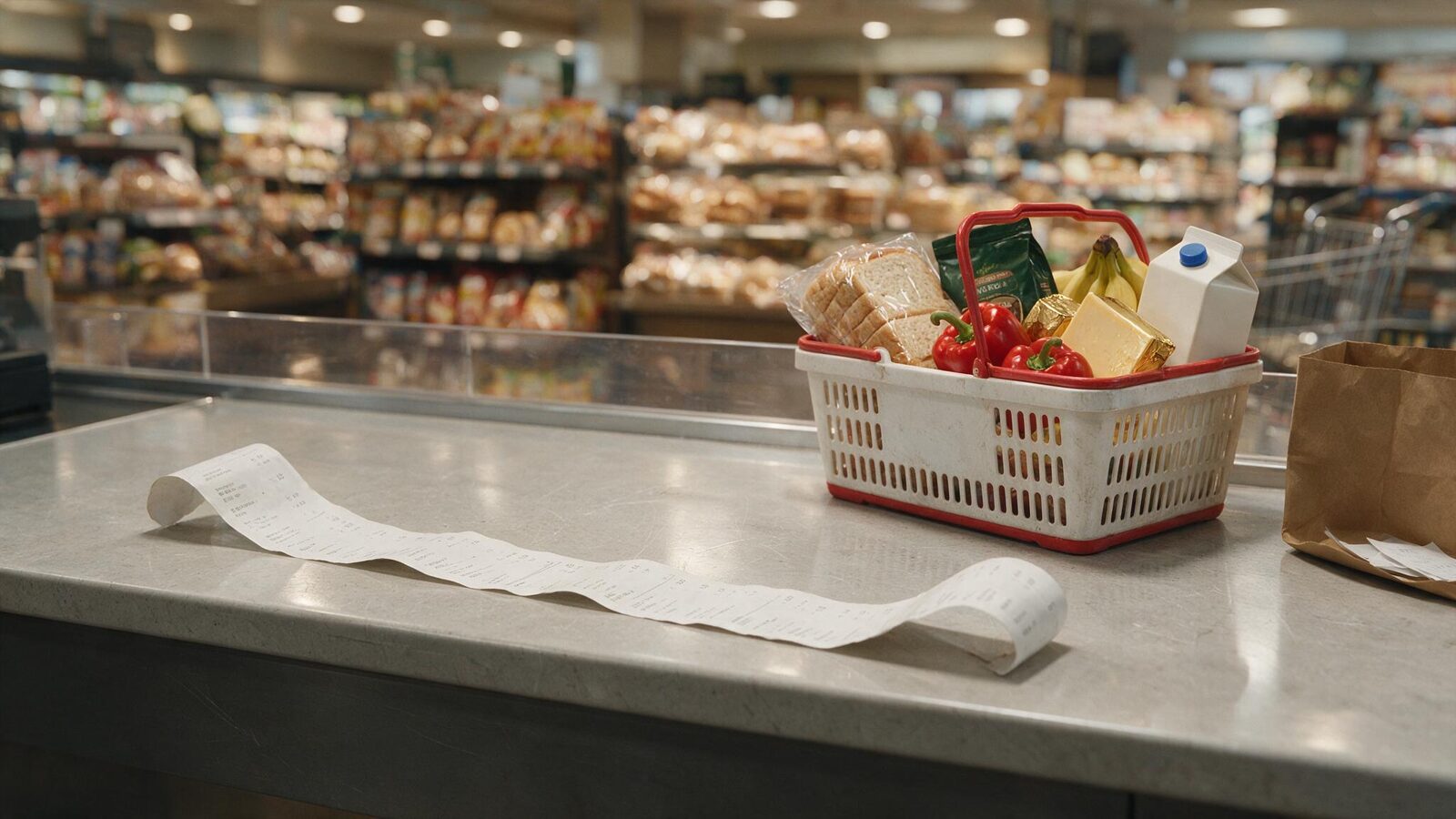
You put fifteen things in the basket. You had a number in your head and it felt about right. Then the screen at the till showed a different number, and the gap was big enough to notice.
This is not carelessness. Holding a running total in your head is not something the human brain is good at, and the layout of a supermarket was not designed to make it easier.
Where the gap comes from
Rounding accumulates. In your head 24.90 becomes 25 and 79.90 becomes 80. On its own that is nothing. Across fifteen items, every rounding that went in your favour adds up.
Items that went in but were never counted. The three or four things not on the list, picked up in passing. They never enter the mental total, because the mental total was built from the list.
What you assumed was a promotion has conditions. Second item discounted, three for two, a discount above a certain spend. When the condition is not met the shelf price applies, but you had already counted the discounted one.
The label and the till disagree. A promotion may have ended without the label being changed. Or the label belongs to the product above, not the one below. What counts is the price at the till.
The pack size changed. The pack that looks identical went from 500 grams to 450 while the price stayed the same. This is called shrinkflation, and it is hard to notice without reading the label.
Spotting shrinkflation
Keeping the price while shrinking the pack is the least noticed way of raising it. The eye is used to the size of a pack, not to its weight.
The only reliable way to catch it is unit pricing again. When a pack goes from 500 grams to 450 and the shelf price holds, the price per kilo rises by eleven percent, and that shows up on the label.
There is also the version where the packaging stays the same and the contents shrink. It is common in crisp bags, detergent bottles and boxed chocolates. Do not decide without checking the weight of the pack in your hand.
Memorising the pack size of five or ten regular purchases once pays off on every trip afterwards. When it changes, you notice immediately.
Unit price: the most useful number on the shelf
There is a small number on the shelf label: the price per kilogram or per litre.
That number is the only honest way to compare two packs of different sizes. You cannot tell whether the 750 gram pack or the 1 kilogram pack is cheaper by looking at pack prices. Unit price answers it at a glance.
A common mistake: the bigger pack is not always cheaper. The promotion may be on the smaller one, or the larger one may be positioned as a family size at a premium. Unit price exposes this.
One more caution: when comparing unit prices, make sure the unit is the same. If one is per kilogram and the other per litre, the comparison is wrong. With products of different density it is an easy trap.
Knowing the total before the till
You have to stop holding it in your head. Three approaches work.
1. Write it as you put it in. Even the notes app on your phone will do. Write the price the moment the item goes into the basket. Do not try to recall it later, because later you will not.
2. Round up, not down. If you are doing mental maths, make 24.90 into 26 rather than 25. That way the error always works in your favour and the surprise at the till is downward, not upward.
3. Set a ceiling and decide against it. Saying up to 800 today is more effective than chasing individual prices. As you approach the ceiling, you decide which item is genuinely needed.
Reading the shelf label quickly
A shelf label usually carries three numbers, and they get confused.
The large one is the selling price, the amount you will pay.
The struck through or smaller one is the regular price, kept as a reference when there is a discount.
The one in small print is the unit price, per kilogram or per litre.
There is also the product name and pack size next to the barcode. If you are not sure whether the label belongs to the item below or the one above, compare that name and size against the pack in your hand. If they do not match, the label is not for that product.
Do not bin the receipt, give it two minutes
Looking at the receipt once after shopping changes the next shop.
Three things to check. First, did the items you thought were on promotion actually ring up discounted. Second, does the price you saw on the label match the price scanned at the till. Third, which are the three most expensive lines on the receipt.
The third is the most instructive. Most people guess wrong about where their money went; they assume it is the small frequent things, when it is usually a few large lines.
If you find a difference between label and till, you can ask for it to be corrected at the checkout. The shelf label is binding.
What to do first
Trying to check every product on every trip is not sustainable.
Start with your biggest lines. Usually a handful of items such as meat, cheese, detergent and coffee make up most of the receipt. Checking unit price on those pays far more than chasing small change on cheap items.
Second step: remember the price of what you buy regularly. If you know a product's normal price, you know whether a discount is real. If you do not, every yellow label is persuasive.
Where Totup fits
Totup records every item you add into a receipt in your pocket. You scan the barcode or the shelf label, the price lands on the receipt, and the total sits in front of you as you go. By the time you reach the till, the number is not a surprise.
One thing to be clear about: Totup does not compare prices between stores. What it does is make your own basket total visible while you are still shopping. In the same scan it also shows the product's Nutri-Score and its sugar, salt and saturated fat lines.
Prices come from user input and label scanning. The price at the till always prevails.
The short version
The gap at the till is not carelessness: rounding accumulates, uncounted items go in, promotion conditions are missed, labels may be out of date, pack sizes may have shrunk.
The most useful number on the shelf is the unit price. The bigger pack is not always cheaper, and you need to be sure the units match.
Stop holding it in your head. Write it as you go, round up, set a ceiling.
Start with the few lines where most of your money goes. If you know the normal price of your regulars, you know whether a discount is real.