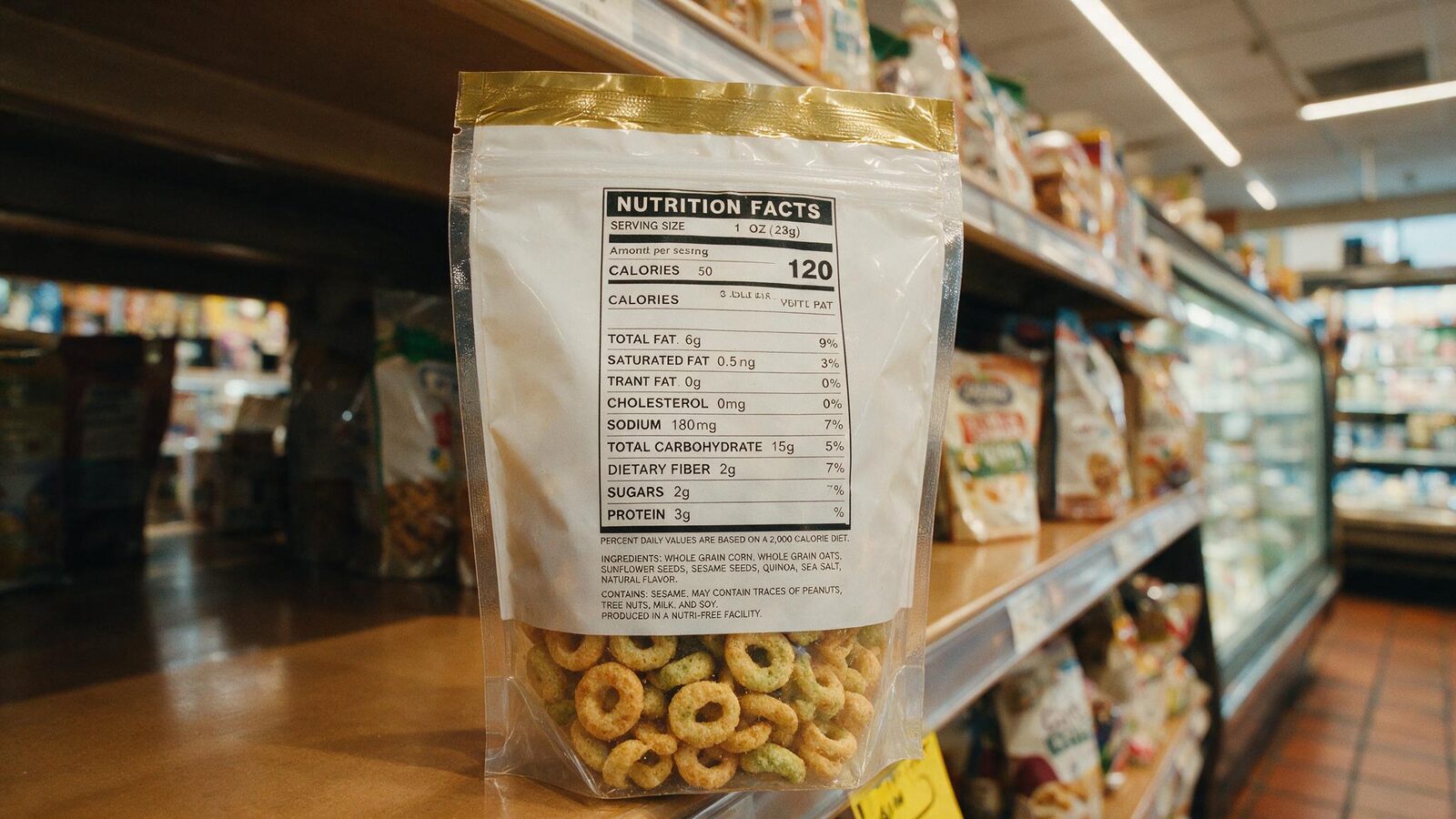
You are holding two packs of biscuits. One says wholegrain, the other says no added sugar. You turned both around and got twenty lines of numbers. You have about thirty seconds and someone is waiting behind you.
Nutri-Score was built for exactly this moment. It compresses those twenty lines into a single letter. But if you do not know what the letter is saying, you will read it wrong, and most people do.
Where the letter comes from
Nutri-Score is not a health claim. It is the result of a calculation, and it runs on 100 grams of the product.
Things that push the score up, which makes the letter worse: energy, sugar, saturated fat, salt.
Things that pull it down, which makes the letter better: fibre, protein, and the share of fruit, vegetables, pulses and nuts.
One is subtracted from the other, the remaining number falls into a band, and that band has a letter. A is dark green, E is dark orange, with B, C and D in between.
The system was developed in France and its scientific basis is the nutrient profiling model of the UK food authority. It is used voluntarily in France, Belgium, Germany, the Netherlands, Spain, Switzerland and Luxembourg. It is not a mandatory label in Türkiye, so you will not see it printed on the pack there; apps read the barcode and pull it from a community database.
The thing most people get wrong
Nutri-Score is not built for comparing across categories.
Putting the letter on olive oil next to the letter on yoghurt and asking which is healthier is not the question the system was designed to answer. Olive oil is dense per 100 grams, and nobody eats 100 grams of olive oil.
The system does its real work between two products on the same shelf doing the same job. Two breakfast cereals. Two instant soups. Two fruit juices. There the letter genuinely separates them, because both are eaten in similar amounts for similar reasons.
The second common mistake: the letter is per 100 grams, not per portion. A 30 gram bag of crisps and a kilo of flour are scored on the same scale. The letter does not know how much you eat. You do.
A concrete example
Picture two breakfast cereals on the same shelf, doing the same job.
The first got a C. Per 100 grams it has 22 grams of sugar, 6 grams of fibre, 0.4 grams of salt.
The second got an A. Per 100 grams it has 8 grams of sugar, 11 grams of fibre, 0.1 grams of salt.
Where did the gap come from? Sugar and fibre. Switching between them removes 14 grams of sugar and adds 5 grams of fibre per 100 grams. That is a lasting difference from changing one product.
Now the wrong comparison. Two rows over there is a bag of walnuts, and it may well have an E. Are walnuts bad now? No. Walnuts are dense in fat and energy per 100 grams, and nobody eats 100 grams of walnuts at breakfast. That is not the question the letter answers.
The rule: compare the letter against what could replace the product. Cereal with cereal, walnuts with almonds.
What the letter does not measure
Honestly, the list is not short.
Degree of processing. Nutri-Score does not look at how many industrial steps a product went through. An ultra processed item can score well if its nutrition table happens to line up.
Additives. Colours, preservatives and sweeteners do not enter the calculation. Only the 2023 update introduced a limited correction for sweetened drinks.
Portion reality. Worth repeating: 100 grams is not what anyone actually eats.
Allergens and personal circumstances. Gluten, lactose, phenylalanine, none of it is in the letter.
So the letter is a starting point, not a finish line. It gets you to a decision in thirty seconds on the shelf. It is not a nutrition plan.
The system was updated in 2023
Nutri-Score is not fixed. A scientific committee revises the formula, and the 2023 update changed several things, which pushed some products down a grade.
Thresholds for sugar and salt were tightened, so the same product now earns a poor letter more easily. Wholegrain products are treated better through fibre. A distinction appeared between red meat and poultry. The scale for drinks was redrawn so that only water can reach an A, and sweetened drinks were pulled back a step.
The practical consequence: a letter you saw quoted in an older source may not match what you see today. Use current data.
How to read it on the shelf, in four steps
1. Pick two products from the same category. Two cereals, two yoghurts, two pasta sauces. Do not compare letters across categories.
2. Look at the letters, then at where the gap comes from. The difference between a C and a B usually comes down to a single line. Most often sugar or salt.
3. Drop down to the traffic lights. A decent app or label shows sugar, salt and saturated fat separately as Low, Medium or High. Look at whichever matters to you. If you watch your blood pressure, the salt line tells you more than the letter does.
4. Ask yourself how much you will actually eat. A pack bought once a month and a product eaten every morning do not carry the same weight. The letter does not know this.
What to do first
If you try to examine every product, you will give up. Start with the ten items you buy most often. Those are the repeats in your kitchen, and they account for most of what you eat.
Learn the letter for each of those ten once. Then check whether a better lettered alternative exists in the same category. Once you find it, it stays found. You do not rethink it every trip.
The rest follows on its own.
Where Totup fits
When you scan a barcode in the store, Totup shows the product's Nutri-Score letter, its sugar, salt and saturated fat lines, and the number of additives. Nutrition data comes from the Open Food Facts community database.
There is something we deliberately do not do: we do not add a verdict. We never call a product good or bad. We show whatever the letter is, from A to E, and whatever the lines say, Low, Medium or High. The call is yours, because we do not know your situation.
In the same scan you can also read the shelf price, turn your basket into a receipt, and see the total before you reach the till.
The short version
Nutri-Score is a nutrition summary calculated per 100 grams. Sugar, salt, saturated fat and energy make the letter worse; fibre, protein and fruit and vegetable content make it better.
Correct use: comparing two products in the same category. Incorrect use: comparing across categories, or treating the letter as portion information.
What it does not measure: processing, additives, portions, allergens.
Start with the ten items you buy most often. Solve those and you have solved most of it.