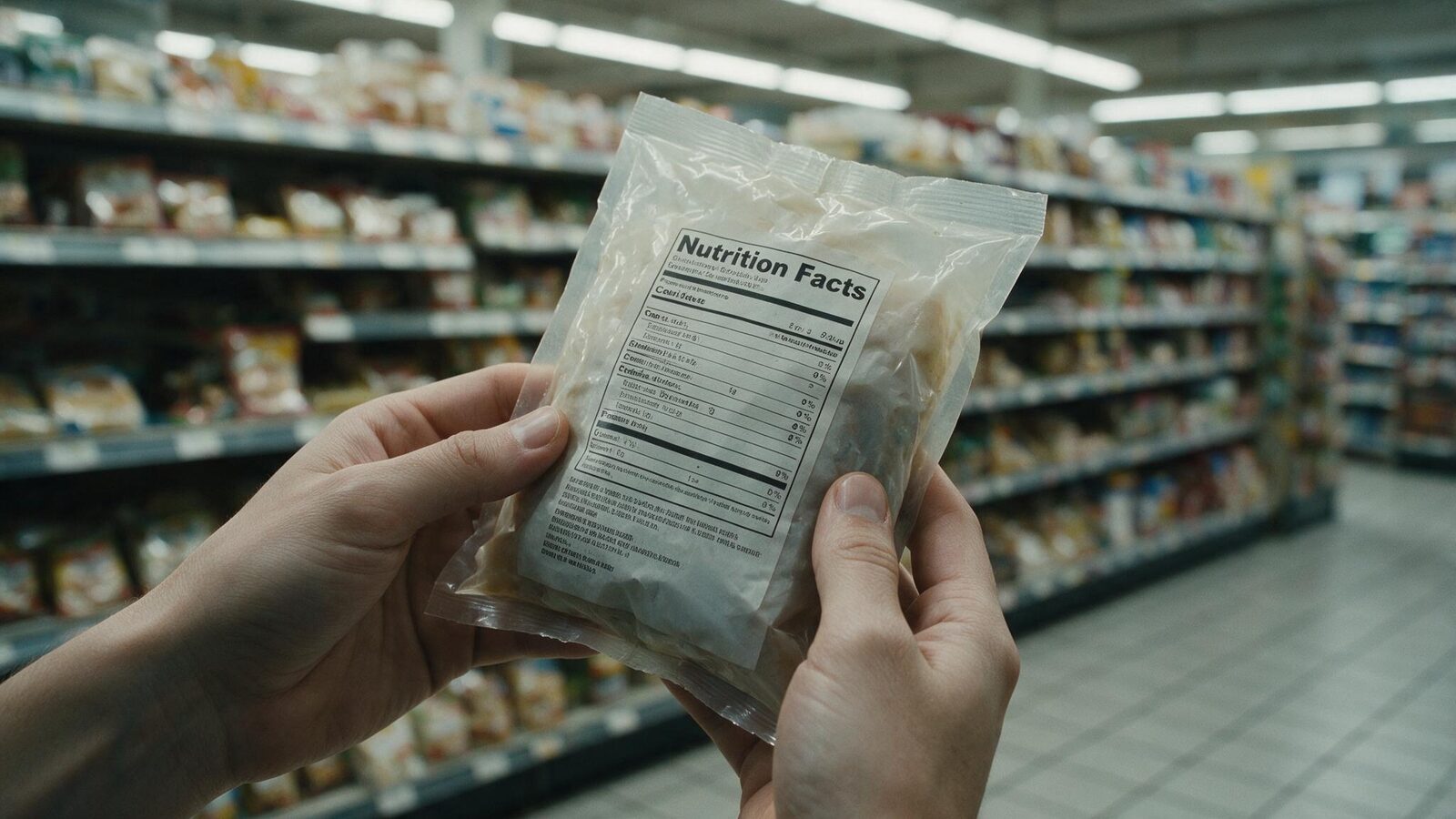
The label says 14 grams of sugar per 100 grams. Is that a lot?
This is where most people stall. The number is right there, but there is nothing to compare it against. Fourteen grams is a lot next to a glass of milk and very little next to a packet of biscuits. Without a scale in your head, a gram figure tells you nothing.
This guide gives you that scale. Three nutrients, three pairs of numbers. Learn them and reading the back of a package drops from thirty seconds to five.
Where the thresholds come from
The thresholds below come from the front-of-pack traffic light system used by the UK food authority. They are widely referenced across Europe, and they are exactly what Totup uses.
All of them are calculated per 100 grams. Package size changes, the threshold does not, because comparison only works on shared ground.
Sugar
| Low | Medium | High |
|---|---|---|
| 5 g or less | between 5 and 22.5 g | over 22.5 g |
22.5 grams is almost a quarter of the 100 grams. Most breakfast cereals, fruit yoghurts and snack bars land above that band.
Salt
| Low | Medium | High |
|---|---|---|
| 0.3 g or less | between 0.3 and 1.5 g | over 1.5 g |
Salt is easy to get wrong because the numbers are small. 1.5 grams looks like nothing, but the World Health Organization puts the daily ceiling for an adult at 5 grams. Eat 200 grams of something with 1.5 grams of salt per 100 grams and most of the day is gone.
One trap: some labels list sodium rather than salt. They are not the same thing. Multiply sodium by 2.5 to get salt. 0.6 grams of sodium is 1.5 grams of salt, which is right at the line.
Saturated fat
| Low | Medium | High |
|---|---|---|
| 1.5 g or less | between 1.5 and 5 g | over 5 g |
Labels usually carry two lines: "fat" and, indented under it, "of which saturates". The threshold is for the second one. Reading the total fat figure and putting the product back is a common mistake; in olive oil or nuts the total is high while the saturated part is low.
For drinks the thresholds halve
Weighing a liquid on the same scale as a solid gives the wrong answer, because you consume far more of it in one go. Per 100 millilitres:
Sugar is low at 2.5 grams and high above 11.25. Saturated fat, 0.75 and 2.5. Salt, 0.3 and 0.75.
A juice with 10 grams of sugar per 100 millilitres looks "medium" on the solid-food scale, but on the drinks scale it sits just under high, and a glass is 200 millilitres.
The portion rule
Reading per 100 grams is the right method for comparison, but it is not the whole story. There is a second rule: if a single portion carries more than 30 grams of sugar, more than 6 grams of saturated fat or more than 1.8 grams of salt, the product counts as high regardless of the per-100-gram figure.
This matters for large packs. A ready meal that looks moderate per 100 grams can have a 400 gram portion.
How to read it in five seconds
- Turn the pack over and find the per 100 g column. The portion column usually sits next to it, so do not mix them up.
- Look at three lines: sugar, salt, saturated fat.
- Compare each against the thresholds: 5 and 22.5. 0.3 and 1.5. 1.5 and 5.
- If it is a drink, halve the thresholds.
- If the label says sodium, multiply by 2.5.
Three numbers do not deserve a verdict on their own. What decides is the gap between this product and the one next to it on the shelf.
What the thresholds do not tell you
They do not tell you whether a product suits you. If you are an athlete, pregnant, on blood pressure medication or following a specific diet, your own limits may be different.
They also say nothing about processing, additives, allergens or how much you actually eat. They put the quantity of three components on a scale. That is far better than having no scale at all, but it is not a full assessment of health.
Where Totup fits in
When you scan a barcode, Totup marks the sugar, salt and saturated fat lines as Low, Medium or High against these exact thresholds. It shows the gram figure next to them, because the medium band is wide and the difference between 6 grams and 22 grams matters.
We never call a product good or bad. We show the number and the band it falls into, and the call is yours. Nutrition data comes from the Open Food Facts community database.
In the same scan you can read the shelf price, turn your basket into a receipt and see the total before you reach the till.
The short version
Per 100 grams: sugar 5 and 22.5, salt 0.3 and 1.5, saturated fat 1.5 and 5. Below is low, between is medium, above is high.
For drinks the thresholds halve. If the label says sodium, multiply by 2.5. If one portion passes 30 grams of sugar, 6 grams of saturated fat or 1.8 grams of salt, it is high whatever the ratio says.
Learn those three pairs. The back of the label will never look like a twenty-line table again.